9 Website Mistakes That Quietly Cost Studios Bookings
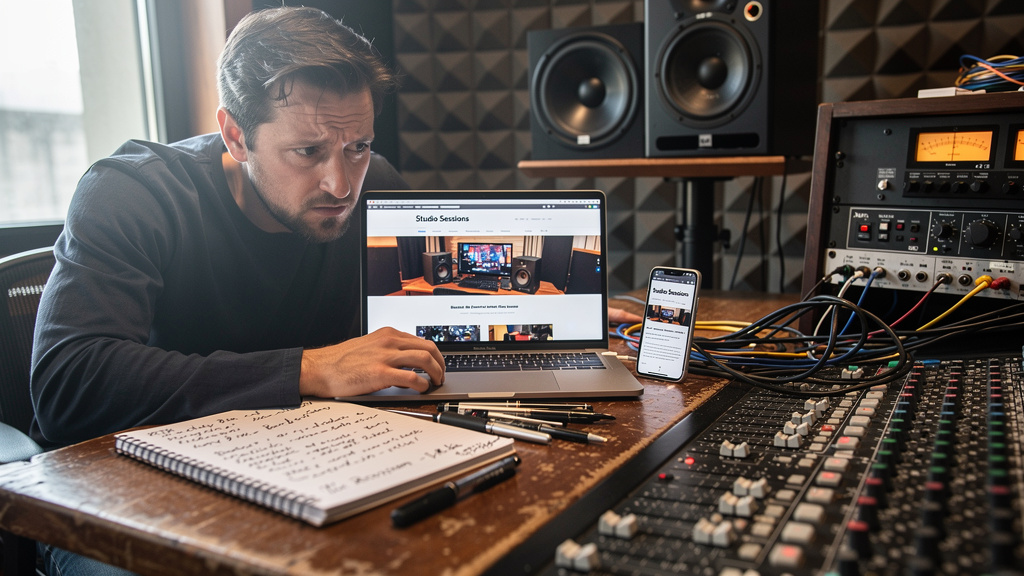
You know the feeling: someone says they found your studio online, they seemed interested, maybe even asked for rates, and then nothing. Or worse, your social posts get attention, your work is solid, your room sounds great, but the website still feels like dead air. For a studio owner, that is a brutal kind of friction. People are ready to buy, but the site makes them hesitate for reasons they may never explain.
A website for a recording studio has one job above all: reduce doubt fast enough that a visitor takes the next step. Not admire your taste. Not decode your menu. Not hunt for your location, rates, or contact form. If the path to booking feels vague, slow, or unfinished, people bail and move on to the next option.
Here are the mistakes that most often cost studios real bookings, and the fixes that make a site start pulling its weight.
Your studio website design puts style ahead of clarity
Creative businesses often overcorrect on aesthetics. Dark video headers, abstract copy, giant carousels, and cinematic language can look impressive, but they also hide the answer visitors want in the first ten seconds: what do you offer, who is it for, where are you, and how do I book?
When studio website design leads with mood instead of clarity, the visitor has to work. That work creates doubt. Doubt kills inquiries.
Your homepage should communicate four things above the fold:
- What you do: recording, mixing, mastering, podcast production, rehearsal, voiceover, production, or a clear combination
- Who you serve: bands, solo artists, podcasters, labels, content creators, agencies
- Where you are: city, neighborhood, remote, in-studio, mobile
- What to do next: book a session, request a quote, schedule a call
If those points are not obvious without scrolling, the site is already making life harder than it should. Great design supports decisions. It should not make people interpret the room.
Your booking path has too many steps
Many studios lose leads between interest and action because the site still treats booking like an email pen-pal exchange. A visitor fills out a generic form, waits a day, gets asked what service they need, replies, waits again, then maybe gets a time option. By then, the momentum is gone.
If you want to get more studio bookings online, remove the drag. A website with online booking does not have to mean every service is bought instantly like a haircut. It means the next step is structured, fast, and visible.
A strong appointment booking website usually gives visitors one of three paths:
- Book now: for standard session types with fixed durations or deposit rules
- Request a quote: for larger projects like EPs, podcast packages, or production work
- Schedule a consult: for clients who need guidance before committing
That separation matters because not every lead is at the same stage. A rapper needing two hours tonight should not be forced through the same funnel as a brand planning a monthly podcast. A cleaner flow converts more people because it respects intent.
If your current setup is clunky, this is exactly where a done-for-you studio website system can pay for itself: fewer abandoned inquiries, less admin back-and-forth, and a faster path from interest to deposit.
You hide pricing so aggressively that it feels evasive
There is a difference between flexible pricing and mysterious pricing. Some studio owners hide every number because they want to “get the lead on a call first.” In practice, that often filters out good clients who simply want to know whether you are in their range.
You do not need to publish every scenario or lock yourself into rigid rates. But you do need enough pricing context to help buyers self-qualify.
Good options include:
- starting rates for common services
- half-day and full-day session pricing
- package examples
- deposit policy
- what is included, such as engineer time, file delivery, edits, or revisions
That level of transparency builds trust. It also saves you from wasting time on inquiries that were never a fit. Buyers are not scared by reasonable pricing. They are scared by uncertainty.
Your portfolio proves talent but not outcomes
Most studio sites have a gallery or audio page, but a surprising number fail to answer the real sales question: why should I trust you with my project?
A portfolio should do more than display polished work. It should connect the kind of client, the problem they had, and the result you delivered. A band wants to know whether you can handle live drums and heavy guitars without chaos. A podcaster wants to know whether you can make dialogue sound clean and consistent every week. A voiceover client wants speed, reliability, and broadcast-ready files.
That means your portfolio needs context. For selected projects, add a short note covering:
- the client type or genre
- the service provided
- the challenge solved
- the result or client feedback
This is one of the biggest differences between a pretty site and a professional website for a creative business that actually converts. Visitors buy fit, not just polish.
Your site reads like it was written for peers, not buyers
Engineers often write website copy to impress other engineers. They lead with gear lists, preamp brands, converter models, and DAW fluency. There is nothing wrong with showing technical credibility, but most clients are not booking because you own a specific compressor. They are booking because they want a result, a feeling, and a process they can trust.
Your copy should translate expertise into client language. Instead of only listing equipment, explain what working with you is like. Fast recalls. Comfortable vocal sessions. Reliable editing. Organized file delivery. Coaching for newer performers. Quiet, focused workflow. Strong communication before and after the session.
Gear supports the sale. Experience closes it.
You are weak on local SEO for studios
A beautiful site will still underperform if nearby clients cannot find it. Local SEO for studios is not glamorous, but it brings in some of the highest-intent traffic you can get: people already searching for a place like yours in your area.
If your pages say “world-class sound” but barely mention your city, neighborhood, or service area, search engines have less confidence about when to show you.
At minimum, your site should include:
- your city and nearby service area in page copy
- a clear location page or contact page
- service-specific pages if you offer distinct work like podcast recording, mixing, mastering, or voiceover
- consistent name, address, and phone details wherever your business appears
For a custom website design for small business, local structure matters as much as visuals. Ranking for “recording studio near me” or “podcast studio in [city]” is often worth more than broad, vague traffic from people who will never book.
Your mobile experience is quietly sabotaging leads
A lot of studio owners review their site on a laptop and assume it is fine. But many of your best leads will first see you on a phone: after hearing a referral, checking your Instagram bio, or searching while on the move.
On mobile, small annoyances become conversion killers fast:
- tiny text
- slow hero videos
- buttons too low on the page
- forms with too many fields
- audio players that break layout
- menus that bury key pages
Run a simple test. Open your homepage on your phone and try to answer these questions in under 15 seconds: What do you offer? Where are you? What does it cost? How do I book? If any answer is hard to find, the mobile experience needs work.
Your inquiry handling stops after the form fill
Many sites act like the job is done once someone submits a form. But the minutes and hours after that submission matter more than most owners realize. If the lead gets a flat “thanks, we’ll be in touch” message and then hears nothing useful, confidence drops immediately.
This is where a CRM and sales funnel website has a real advantage. Good follow-up should feel organized, not robotic. The goal is to keep momentum while answering the next questions before the client has to ask.
A better post-inquiry sequence looks like this:
- Instant confirmation: let them know the message arrived
- Expectation setting: tell them when they will hear back
- Useful next step: invite them to book a consult, review rates, or send project details
- Reminder follow-up: if they go quiet, send a polite check-in
This alone can recover leads that would otherwise disappear. For busy studio owners, automation is not about sounding corporate. It is about being reliably responsive even while you are in sessions.
You treat the website like a brochure instead of part of the business
The highest-performing studio sites are not static portfolios. They are working systems. They guide visitors, capture demand, pre-qualify leads, answer common objections, and shorten the distance between interest and payment.
That shift matters because your website is often the first assistant your business has. If it cannot explain your services clearly, route people to the right offer, and support follow-up, you end up doing too much manually.
Here is a practical way to audit your site this week:
- Ask a friend who fits your target client to open the site on their phone
- Give them 20 seconds to figure out what you offer and how to book
- Watch where they hesitate
- Count the number of clicks from homepage to inquiry or booking
- Check whether pricing, location, and service details are easy to find
- Submit your own form and review the follow-up experience
That short exercise reveals most conversion problems quickly. And if you are seeing the gaps but do not want to spend nights rebuilding your site, it may be time to hire a web designer for your studio who understands both creative businesses and booking flow.
Studios rarely lose bookings because the audio work is not good enough. More often, they lose them because the website leaves too many unanswered questions at the exact moment a buyer wants certainty. Fix the confusion, shorten the path, and make the next step obvious. When the site starts doing that job well, your calendar usually feels the difference before your traffic numbers do.
Comments (0)
Leave a Comment
No comments yet. Be the first to comment!