BMI Calculator: What Your Number Really Means
BMI Calculator: What Your Number Really Means
You step on the scale, you see a number, and you have absolutely no idea what to do with it. Sound familiar? Most people have been there — caught somewhere between "I think I'm doing okay" and "should I be worried about this?" The frustrating part is that weight alone tells you almost nothing meaningful about your health. That's exactly where a BMI calculator comes in, and why so many doctors, trainers, and health-conscious people still rely on it as a starting point.
But here's the thing: most people either obsess over their BMI number without context or dismiss it entirely as outdated. The truth sits somewhere in the middle, and once you actually understand what your score means — and what it doesn't — you'll be in a much better position to make real decisions about your health.
Let's get into it.
What Is BMI and Why Does It Matter?
BMI stands for Body Mass Index, and at its core, it's a simple ratio between your weight and your height. It was developed in the 1830s by a Belgian mathematician named Adolphe Quetelet, which yes, does make it older than your grandmother's cast iron skillet. But it's stuck around for a reason.
The reason BMI still matters in 2024 is that it gives healthcare providers and individuals a fast, cost-free, non-invasive way to screen for potential weight-related health risks. You don't need a lab, a doctor's appointment, or expensive equipment. You just need two measurements and a formula — or better yet, a tool that does the math for you instantly.
It's used globally in clinical settings, public health research, and personal wellness planning. Is it perfect? No. But as a starting point for understanding your body's relationship with weight, it's genuinely useful — as long as you know how to read the results properly.
How to Calculate Your Body Mass Index (The Right Way)
The formula itself is straightforward:
BMI = weight (kg) ÷ height² (m²)
If you're working in imperial measurements (pounds and inches), the formula adjusts slightly:
BMI = (weight in lbs ÷ height in inches²) × 703
So, for example, if you weigh 160 pounds and stand 5'7" (67 inches tall):
BMI = (160 ÷ 67²) × 703 = (160 ÷ 4,489) × 703 ≈ 25.1
That puts you just at the border of the "normal" and "overweight" categories — which is exactly the kind of nuance that matters.
If you'd rather skip the arithmetic (and honestly, who wouldn't), you can calculate your BMI instantly with this free tool. It handles both metric and imperial units, gives you your result in seconds, and takes the guesswork out of the equation entirely.
Breaking Down the BMI Categories: Underweight to Obese
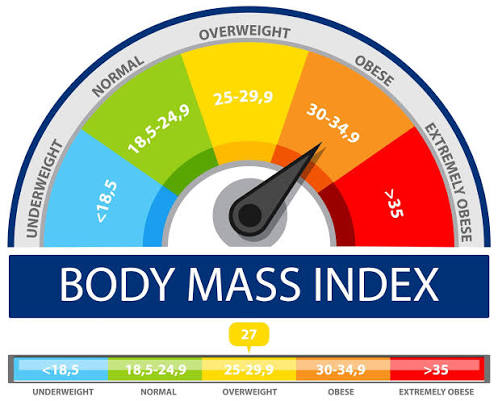
Once you have your number, here's how it maps to the standard WHO classifications:
| BMI Range | Category | |---|---| | Below 18.5 | Underweight | | 18.5 – 24.9 | Normal weight | | 25.0 – 29.9 | Overweight | | 30.0 and above | Obese |
The "Obese" category is further broken into Class I (30–34.9), Class II (35–39.9), and Class III (40+), sometimes referred to as severe or morbid obesity in clinical contexts.
These ranges were established based on large population studies that identified correlations between BMI levels and health outcomes like cardiovascular disease, type 2 diabetes, hypertension, and certain cancers. They're not arbitrary — but they're also not the whole story, which we'll get to shortly.
What Your BMI Number Is Actually Telling You
Here's where people often get tripped up. Your BMI number isn't a diagnosis. It's a signal — a prompt to look closer.
If your BMI falls in the underweight range, it could indicate nutritional deficiencies, an underlying health condition, or insufficient caloric intake. It's worth discussing with a doctor, especially if you've noticed fatigue, hair loss, or difficulty concentrating.
If you're in the normal range, that's generally a positive indicator, but it doesn't mean you're automatically healthy. Someone with a BMI of 22 who never exercises and eats poorly can still have metabolic issues. BMI doesn't measure fitness.
If you're in the overweight range, this is often where people panic unnecessarily. A BMI between 25 and 27, for many people, carries minimal added health risk — especially if you're physically active and have good blood pressure and cholesterol levels. Context matters enormously here.
If your BMI falls in the obese range, it does statistically increase your risk for several serious conditions. That's not meant to be alarming — it's meant to be actionable. Knowing where you stand is the first step toward making changes that actually stick.
The Limitations of BMI You Should Know About
Let's be honest about what BMI gets wrong, because there are real gaps worth understanding.
It doesn't distinguish between fat and muscle. This is the big one. A professional athlete with 8% body fat and significant muscle mass might register as "overweight" on the BMI scale. Meanwhile, someone with a "normal" BMI could have a high percentage of visceral fat — the dangerous kind that wraps around your organs.
It doesn't account for where fat is stored. Belly fat (central adiposity) is far more metabolically risky than fat stored in the hips or thighs. BMI can't tell the difference.
It doesn't adjust well for age, sex, or ethnicity. Older adults naturally lose muscle mass and gain fat, so the same BMI can mean different things at 30 versus 65. Research also shows that people of Asian descent may face higher health risks at lower BMI thresholds than the standard categories suggest.
It's a population-level tool being applied individually. BMI was originally designed to study trends across large groups, not to assess individual health. That context matters.
None of this means you should ignore your BMI — it just means you should read it as one data point among several.
BMI vs. Other Health Metrics: Which One Wins?
No single metric wins, honestly. The smartest approach is using multiple measurements together.
Waist circumference is one of the most underrated health indicators. A waist measurement above 40 inches for men or 35 inches for women is associated with significantly higher cardiovascular risk, regardless of BMI.
Waist-to-hip ratio takes it a step further by comparing fat distribution between your midsection and hips, giving a clearer picture of central obesity.
Body fat percentage is arguably more accurate than BMI for assessing body composition, but measuring it properly requires tools like DEXA scans, hydrostatic weighing, or at minimum a reliable set of calipers — none of which you can do at home in two minutes.
Blood markers — including fasting glucose, HbA1c, cholesterol panels, and blood pressure — tell you things about your metabolic health that no external measurement can.
Think of BMI as the first screening layer. It's fast, free, and accessible. Use it to get oriented, then dig deeper with other metrics as needed.
How to Use Your BMI to Set Realistic Fitness Goals
This is where BMI actually becomes practical rather than just theoretical.
If you're trying to move from overweight to normal range, a rough target is losing 5–10% of your current body weight. Research consistently shows that even modest weight loss in this range produces meaningful improvements in blood pressure, blood sugar, and cholesterol — often before you even hit your "goal" weight.
Start by getting a clear baseline. Go ahead and calculate your BMI instantly with this free tool if you haven't already. Write down your number, your category, and the date. This is your starting point, not a verdict.
From there, work backward. If you're 5'6" and currently weigh 190 pounds (BMI ≈ 30.7), getting to a BMI of 25 means reaching about 155 pounds — a difference of 35 pounds. That might feel overwhelming as a single goal, but breaking it into 5-pound milestones makes it completely manageable.
Pair your BMI tracking with at least one other metric — waist circumference is easiest — so you can see changes in body composition even when the scale moves slowly. Muscle gain and fat loss can sometimes cancel each other out on the scale while your body is genuinely improving.
Revisit your BMI every 4–6 weeks rather than obsessing over it daily. Weight fluctuates based on hydration, hormones, and a dozen other factors. Trends over time are what matter.
Frequently Asked Questions About BMI
Is BMI accurate for everyone?
It's a reasonable screening tool for most adults, but it's less reliable for athletes with high muscle mass, older adults with muscle loss, pregnant women, and people of certain ethnic backgrounds. Always interpret your result with those caveats in mind.
What's considered a healthy BMI?
The standard healthy range is 18.5 to 24.9. However, some research suggests that the optimal range for longevity may be slightly higher — around 22 to 27 — particularly for older adults.
Can children use a BMI calculator?
Children and teenagers use a different version of BMI that accounts for age and sex, called BMI-for-age. The adult BMI categories don't apply to people under 18.
How often should I check my BMI?
Monthly or every few weeks is plenty if you're actively working on weight management. If you're just monitoring for general wellness, a few times a year is fine.
Does a normal BMI mean I'm healthy?
Not necessarily. BMI is one indicator among many. You can have a normal BMI and still have poor metabolic health, low fitness levels, or nutritional deficiencies. Think of it as a starting conversation, not a final answer.
What should I do if my BMI is in the obese range?
Talk to your doctor. A BMI in that range warrants a closer look at your metabolic health markers, and a healthcare provider can help you build a plan that's realistic and sustainable — not just focused on the number itself.
Your BMI score is genuinely useful information when you know how to use it. It's not a judgment, it's not a life sentence, and it's definitely not the only thing that matters. But it is a real, evidence-backed starting point for understanding where your body is right now — and where you want to take it.
If you haven't checked yours recently, there's no reason to wait. Calculate your BMI instantly with this free tool and give yourself a clear baseline to work from. Knowledge is the first step toward change that actually lasts.
Comments (0)
Leave a Comment
No comments yet. Be the first to comment!