Stop Blaming Dirty Power for Every Studio Hum
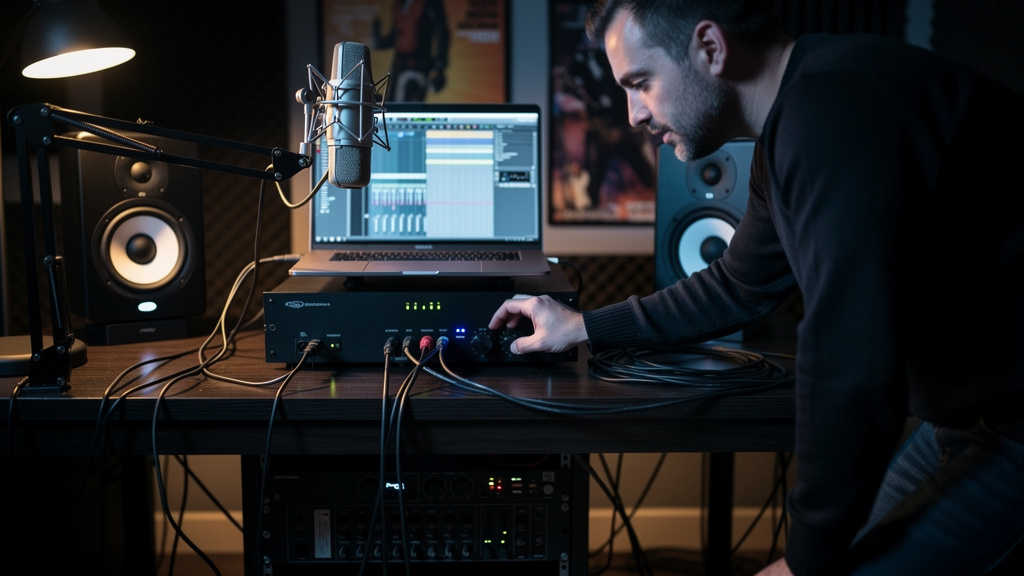
You line up a vocal that finally has the right tone, the singer nails the quiet line, and there it is again: that low, steady hum living underneath the take like a stain. Not loud enough to stop the session, not subtle enough to ignore. So you start eyeing expensive rack power conditioners, wondering if the room’s wiring is doomed and whether “dirty power” is the monster hiding in your studio. I get the instinct. Power feels mysterious, permanent, bigger than your gear. But in a lot of home studios, that hum is far more ordinary—and far more fixable—than it first appears.
The good news is that a truly quiet room is not reserved for commercial facilities with isolated technical power and six-figure buildouts. In many cases, the path to a dead-silent noise floor starts with understanding what kind of noise you’re actually hearing, and why blaming the wall outlet too early sends people toward the wrong fix.
The sound you want is closer than you think
Most people don’t chase silence because they’re obsessive. They chase it because noise changes the way you work. It makes you second-guess gain. It tempts you to over-process. It steals intimacy from soft performances and edge from fast transients. A vocal recorded over low hum never quite feels settled, even before the mix starts.
When the source of that hum gets removed properly, the whole session changes. You stop EQing around a problem that should not exist. Compressors stop pulling up garbage between phrases. Reverbs feel cleaner because they’re not smearing electrical junk into the tails. The studio suddenly behaves like you always thought it should.
That relief matters, because it shifts the problem from “my room is cursed” to “this is a solvable system issue.” And that is usually the truth.
Why “dirty power” gets blamed so often
Home studio hum gets called a power problem because it seems logical. Everything plugs into the wall. The noise is low-frequency. Maybe the building is old. Maybe the dimmers in the next room are ugly. Maybe the refrigerator kicks on and something changes. All fair suspicions.
But a lot of studio hum is not coming from the AC line as some vague layer of contamination. It is happening because your gear gives that electrical system multiple paths to ground, and those paths do not all sit at exactly the same potential. The result is current flowing where you do not want it flowing—through shields and audio connections that should be carrying reference, not unwanted energy.
That is the core of the myth: people hear hum, think “bad electricity,” and buy a box that filters or regulates power. Meanwhile the actual issue is created by how the interface, monitors, outboard gear, computer, display, USB devices, and cable shields are connected together.
If you want a practical visual framework for thinking through that without forum guesswork, this noise-tracing workbook for studio owners is a strong resource because it helps you identify where the hum is born before you spend money trying to suppress it.
Hum has a fingerprint. Learn to read it.
Before you can believe the fix is straightforward, you need to trust your ears a little more specifically. Not every unwanted sound points to the same cause.
- Low steady hum often points toward grounding relationships, loop current, or induced mains-related noise.
- Buzz with extra edge or harmonics can suggest lighting dimmers, displays, switching supplies, or unbalanced runs near power.
- Whine, hash, or chirping is more commonly tied to USB, computer activity, graphics hardware, or cheap power adapters.
- Hiss is usually a gain or device noise-floor issue, not a grounding problem.
That distinction matters because people treat all noise like one enemy. It is not. A low 50/60 Hz family hum is a very different troubleshooting story from broadband hiss or digital chatter. If the symptom is wrong, the cure will be wrong too.
What expensive power conditioners actually do—and don’t do
This is where the conversation usually gets distorted. Power conditioners are not fake. They can be useful. The problem is what people expect them to fix.
A rack unit may provide some combination of surge protection, EMI/RFI filtering, distribution convenience, voltage monitoring, or sequencing. Those can all be worthwhile features in the right setup. What it usually does not do is magically remove a ground loop that exists between connected pieces of audio equipment.
If two devices are tied together by audio cabling and also tied together through the safety ground of the AC system, the loop exists whether the outlet strip is expensive or not. Filtering the incoming AC does not rewrite the topology of the signal path. That is why someone can spend real money on power treatment and hear absolutely no change in the hum they were trying to kill.
There are exceptions. Some environments really do have power-related problems severe enough to affect equipment behavior. But those are not the first bet in most home rooms. The first bet should be signal flow and grounding relationships between devices.
Where the hum usually begins in a home studio
The common pattern is simple: one rig grows into five rigs. A laptop joins the interface. External monitors get added. Then a screen, a USB hub, a synth, maybe a pedalboard, maybe a reamp box, maybe outboard compression. Every addition creates another electrical relationship. Quiet setups become noisy gradually, which is why the cause feels invisible.
These are the places I see the trouble start most often:
- Interfaces feeding powered monitors over unbalanced connections
- Computer-connected rigs where USB power and audio ground interact badly
- Outboard gear added to a mostly in-the-box setup without a clean grounding plan
- Consumer gear mixed with pro gear, especially when nominal levels and connector types differ
- Long cable runs draped alongside wall warts, power bricks, and extension cords
- Multiple devices plugged into different branches of household power around the room
Notice that only one of those is really about the building itself. The rest are about how the studio is interconnected inside that building.
The belief shift: silence comes from topology, not magic
Once you accept that hum is usually a system-layout problem, the whole subject gets less mystical. You stop hunting miracle products and start asking better questions.
Questions like: Where is the first point in the chain where the hum appears? Does it exist with monitors on and interface disconnected? Does it appear only when the computer is attached? Does balanced wiring exist everywhere it reasonably can? Did the problem begin when one new device entered the setup? Does lifting an audio shield at the correct end of a properly designed connection solve a reference issue, or is the rig depending on unsafe shortcuts?
That last point matters enough to say plainly: do not defeat safety earth on mains-powered equipment. Hum that disappears when someone uses a dangerous adapter has not been solved. It has only been masked by removing protection that exists to save lives.
Good troubleshooting is not glamorous, but it is reliable. You reduce the system to known pieces, rebuild with intention, and find the exact relationship that creates the noise.
What to do before you buy another box
You do not need a full teardown every time a monitor hums, but you do need an order of operations. A smart approach usually looks like this:
- Identify the noise type. Hum, buzz, whine, and hiss do not point to the same failure.
- Find the earliest appearance. Determine the first device or connection where the noise enters the chain.
- Simplify the rig. Strip the setup to interface, one source, and monitors or headphones, then add devices back one at a time.
- Check connection format. Balanced outputs into balanced inputs are not a luxury in a studio; they are often the baseline for quiet operation.
- Review power distribution. Keep interconnected audio gear on a sensible common power scheme before assuming the house wiring is the villain.
- Separate power and signal physically. Cable routing still matters, especially around wall warts and adapters.
Notice what is not on that list: “Buy a premium conditioner first.” Not because those units never help, but because they are usually downstream of the real diagnosis.
When the house wiring really is part of the story
Sometimes the building does deserve suspicion. Old homes can have questionable grounding, shared circuits with noisy appliances, reversed polarity at outlets, or inconsistent wiring work done over decades. If your studio shows symptoms beyond audio hum—lights dipping, breakers behaving oddly, gear reacting unpredictably—bring in a qualified electrician. That is not defeat. That is professionalism.
But even then, keep your expectations calibrated. Better branch wiring can improve safety and stability. It may reduce some noise opportunities. It still does not replace clean signal-path practice. A beautifully wired room can hum if the gear interconnection is wrong. A modest room can be impressively quiet if the signal path is thought through properly.
The real win is confidence, not just silence
What you are after is not merely the absence of hum. It is the confidence to hear a problem and know where to look first. That changes how you buy gear, how you wire expansions, and how quickly you recover when noise shows up before a session.
It also protects you from the most expensive habit in studio ownership: solving undefined problems with hardware purchases. A lot of noise budgets disappear that way.
If you want a structured way to think through hum, grounding, and source-level diagnosis without bouncing between conflicting opinions, I’d recommend Kill the Noise. It’s built for studio owners who want to stop guessing and get back to recording with a genuinely quiet floor.
Comments (0)
Leave a Comment
No comments yet. Be the first to comment!