Studio Hum Myths: Why the Expensive Box Isn’t the Fix
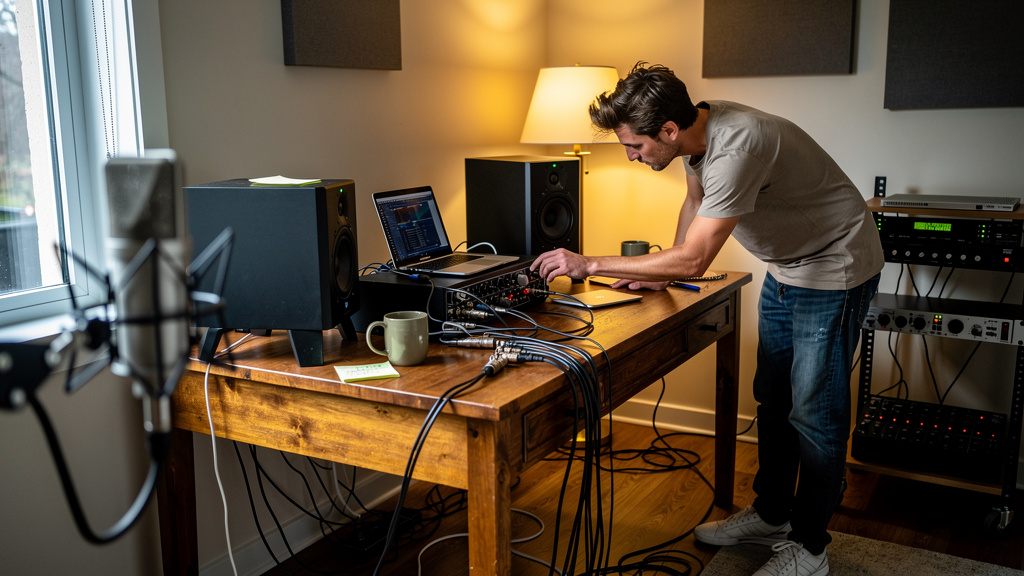
You know the feeling: the vocal was right, the performance had tension and detail, and then you solo the track and there it is—that low, stubborn hum sitting under the take like a bad light dimmer in the next room. Not loud enough to scream disaster, but present enough to soften the whole moment. It makes you second-guess your room, your interface, your preamps, your house wiring, maybe even your sanity. And somewhere along the way, somebody tells you the answer is a thousand-dollar rack power conditioner.
Usually, it isn’t.
That’s actually good news, because most studio hum problems in home and project rooms are far more ordinary than they seem. They feel mysterious because electricity is invisible and forum advice is wildly inconsistent. But the path to a quieter studio is often less about buying a heroic box and more about understanding where current wants to travel, where audio gear gives it extra paths, and why those paths turn into audible noise.
The expensive power myth survives because it sounds plausible
“Dirty power” has become a catch-all phrase. It gets used to describe hum, buzz, hiss, clicks, hash, grounding faults, unstable outlets, and random gremlins that may have nothing to do with one another. Once everything gets lumped into one scary category, the premium cure starts to sound reasonable: put a conditioner in the rack, plug everything into it, and expect silence.
That works often enough to keep the myth alive, but not for the reason people think. In many cases, the apparent fix comes from powering multiple devices from a common point, which can change how grounds interact. The magic is not the price tag. The magic is in reducing opportunities for small voltage differences to circulate through the audio path.
A rack conditioner can help with outlet distribution, basic surge protection, and sometimes filtering of certain junk on the AC line. What it usually does not do is solve a classic ground loop that’s happening between interconnected devices. If your interface, powered monitors, outboard gear, computer, and cable TV ground all give electrical current multiple routes home, hum can still be there whether the front panel glows blue or not.
What hum actually is in a home studio
When people say “hum,” they often mean one of two families of noise. The first is low-frequency mains hum, typically centered around your local power frequency and often accompanied by harmonics above it. The second is buzz or hash, which tends to sound rougher, brighter, and more aggressive. They have different causes, even though they get blamed on the same outlet.
Low hum often comes from ground potential differences between connected gear. In plain English: two devices that are supposed to share the same reference point don’t quite agree on what ground is. Connect them with audio cabling and a small current starts flowing where audio is supposed to live. Your monitoring chain turns that current into a tone.
Buzz can come from lighting dimmers, laptop chargers, poor shielding, wall warts, bad cable runs near AC adapters, USB power contamination, or transformer radiation from gear placed too close together. That distinction matters, because if you misidentify the sound, you spend money solving the wrong problem.
If the noise changes when certain audio cables are connected or disconnected, you’re usually dealing with the signal path—not a mythical blanket of “bad power” covering the whole room.
Why home wiring matters less than people assume—and more in one specific way
Home wiring does matter, but often not in the dramatic way marketing suggests. In many studios, the branch circuit itself is basically adequate. The wall power may not be pristine, but it also may not be the thing adding hum to your recordings. Audio systems are built to reject a lot of normal AC-world mess. The trouble begins when several grounded devices are interconnected in ways that create loops.
Where house wiring does become critical is safety and grounding integrity. An open ground, reversed polarity, bootleg ground, or badly wired outlet is not just a noise problem. It is a fault condition. That’s when you stop thinking like a musician trying to finish a session and start thinking like someone who needs a qualified electrician involved. No vocal take is worth guessing around unsafe mains wiring.
But here’s the key distinction: unsafe electrical faults are one category. Routine studio hum caused by interconnected equipment is another. Confusing them is what pushes people toward buying the wrong fix.
The signal path is where most loops are born
Take a common home studio setup: desktop computer on one outlet, interface on another strip, powered speakers grounded through their own cables, maybe an external display, a synth, and a USB-powered accessory in the mix. Every one of those devices creates relationships between chassis ground, shield connections, and AC earth. Add unbalanced connections where balanced ones should be used, and now shield current has an easy way to become audible.
This is why hum often appears only after one specific connection is made. The system can seem quiet until the monitor outputs hit the speakers, or until the laptop power supply gets connected, or until the synth returns enter the interface. The noise is not floating around the room waiting to attack. It is being invited into a loop by the way the chain is assembled.
That is also why random gear swapping rarely leads to a permanent fix. You can replace an interface, move power strips, and even change monitors, yet the hum survives because the relationship between devices never changed.
Balanced lines are not just a feature list item
One reason serious studio gear leans on balanced connections is that they make the system much less vulnerable to the little ground-related voltage differences that plague project rooms. A proper balanced output feeding a proper balanced input allows the receiving device to focus on the difference between the signal conductors while rejecting noise common to both.
That does not mean balanced wiring is magic. A badly implemented balanced stage, a miswired cable, or gear with pin-1 and shielding issues can still cause trouble. But when your room has hum and your monitor path or outboard chain is running unbalanced where balanced I/O is available, that is a meaningful clue. Not a guarantee—just a clue with real weight.
This is exactly where people burn hours online chasing opinions. The better move is to work from a structured diagnosis so you can tell whether the problem is outlet-related, cable-related, device-related, or topology-related. That’s what the Kill the Noise workbook is built for: a visual troubleshooting system that helps you stop guessing and isolate the source with confidence.
Why a conditioner sometimes seems to work
Let’s be fair to the hardware. There are situations where a power product improves things. If it provides a central point that changes how your system is powered, you may reduce ground differences enough to hear a benefit. If it filters a specific kind of high-frequency contamination, you may hear less hash. If your previous setup used scattered wall warts and daisy-chained strips, simply reorganizing power distribution can tidy up the system.
But those wins do not prove that every hum problem is “dirty power,” and they definitely do not prove that high price equals silence. A unit can be beautifully made and still irrelevant to the actual fault in your room.
The more useful question is not “Which conditioner should I buy?” It’s “Where is the unwanted current entering my audio chain?” Once you ask that, your decisions get sharper. You stop treating every symptom with the same expensive box.
Signs you’re dealing with a loop, not a failing room
A few patterns come up again and again. The hum appears only when your speakers are connected to the interface. It changes when the laptop charger is plugged in. It vanishes on headphones but returns through monitors. It gets worse when an external display, cable modem, or synth is added. It changes character when a cable route moves near a power adapter. Those are system-interaction clues.
Another tell is that your recordings may be cleaner than your monitoring, or the reverse. If the noise is only in playback, your monitor chain is suspect. If it is being captured at record time, the problem may be upstream at the instrument, DI, preamp, USB connection, or analog input stage. Same word—hum—different part of the chain.
That distinction matters because a dead-silent noise floor is built one segment at a time. You want your transients to stay sharp because the system underneath them is stable, not because you had to carve away low-end junk after the fact.
What not to do when you’re desperate
When sessions are backing up, people get tempted by unsafe shortcuts: defeating grounds, using sketchy adapters, lifting earth on powered speakers, or keeping “temporary” fixes in place for months. Don’t. If a solution compromises electrical safety, it is not a solution.
Likewise, avoid making three changes at once and then trying to judge the result. Hum problems are frustrating partly because they reward patience and punish randomness. One cable change, one device relationship, one power connection choice can tell you more than a whole evening of wholesale rewiring.
And if you are hearing transformer field pickup, mechanical hum from hardware, or vibration through furniture, recognize that not every low-frequency nuisance is traveling through the AC line. Some noise enters electrically, some enters acoustically, and some is induced by proximity. Good troubleshooting starts by separating those categories before money gets spent.
Belief comes from seeing the pattern
The turning point for most studio owners is not buying a product. It’s realizing the noise is understandable. Once you can tell the difference between a grounding issue, a cable topology issue, and a true electrical fault, the whole room feels less haunted. You stop blaming your home, stop distrusting every piece of gear, and start making decisions that actually move the noise floor down.
That’s the relief on the other side of this: a session where the monitors come up and nothing rides underneath the music. No low throb under the vocal. No buzz clouding the tail of a reverb. Just clean space, solid imaging, and transients that hit without a layer of grime underneath.
If your studio keeps pulling you into conflicting forum threads and expensive guesses, Kill the Noise is the resource I’d recommend. It walks you through the logic of studio noise so you can solve the actual cause instead of buying around it.
Comments (0)
Leave a Comment
No comments yet. Be the first to comment!