Website Features Every Studio Owner Actually Needs
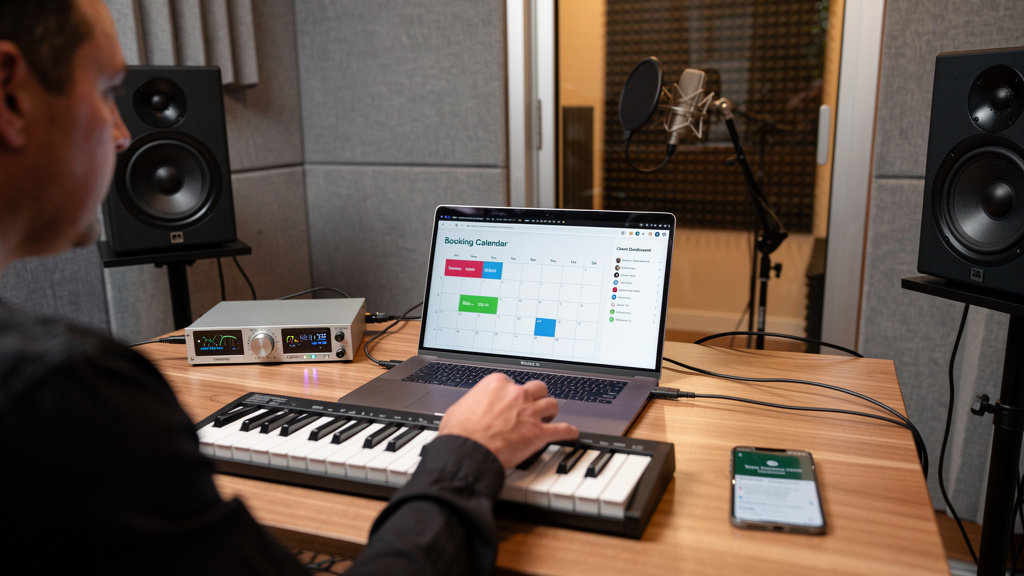
You know the feeling: someone messages at 11:40 p.m. asking for rates, another lead fills out a vague contact form and disappears, and a past client meant to book mixing next month slips off your radar because their details are buried in email. None of that feels like “marketing.” It feels like dropped momentum. And for a studio owner, dropped momentum usually turns into empty calendar space.
A strong website for a recording studio should do more than look polished and play a nice reel. It should reduce friction between interest and payment. It should answer the practical questions serious clients have, qualify people who are not a fit, and keep warm leads moving without you chasing every message manually.
That does not mean your site needs to be bloated. It means it needs the right systems. If you are planning a studio website design from scratch, or fixing one that already exists, these are the features that do the real work.
1. A booking flow that matches how your studio actually sells
Most studio owners hear “website with online booking” and imagine a basic calendar widget. That is only useful if your service is simple enough to buy in one step. Many studios are not built that way. Tracking vocals for two hours, booking a full-day band session, podcast production, editing, mixing and monthly content retainers all have different sales paths.
Your booking setup should reflect that reality. In practice, a smart appointment booking website usually separates services into three buckets:
- Instant-book services: straightforward sessions with fixed duration and pricing
- Application or inquiry services: larger projects that need scoping before scheduling
- Discovery-call services: higher-ticket work where the client needs a short consult first
If every service goes through the same generic “Contact Us” form, you create drag. If every service is forced into instant checkout, you invite bad-fit bookings and pricing confusion. The win is matching the action to the service.
A good booking flow should also include:
- live availability or request windows
- clear session lengths and turnaround expectations
- deposit collection before the slot is held
- intake questions about project type, files, headcount or gear needs
- automatic confirmation and reminder emails
- reschedule rules that are visible before payment
That combination does two things at once: it makes it easier for serious clients to commit, and it filters out time-wasting back-and-forth. If you want to get more studio bookings online, this is one of the highest-leverage places to tighten the experience.
2. A CRM that remembers what your inbox forgets
Studios lose business in quiet ways. Not because demand disappears, but because follow-up depends on memory. A lead asks about voiceover work, you reply between sessions, they say “maybe next month,” and then the thread sinks. That is exactly where a CRM earns its keep.
A CRM and sales funnel website is not just for big agencies or tech companies. For a working studio, a CRM should act like a central memory for every inquiry, client, quote and follow-up. It tells you who asked what, when they last heard from you, what service they wanted and what should happen next.
At minimum, your CRM should track:
- new leads from forms, ads, search and referrals
- current status of each inquiry
- booked clients and project history
- estimates, deposits and service interest
- follow-up dates and automated reminders
- email activity and campaign engagement
Without that structure, your website collects interest but does not convert it consistently. With it, you can spot patterns fast. Maybe podcast clients book quickly after a rate guide. Maybe mixing leads need two touches before buying. Maybe old band clients come back every six months if reminded at the right time.
This is one reason many owners eventually choose a done-for-you website built for studios instead of piecing tools together. The website is only half the job; the follow-up system behind it is where a lot of revenue either compounds or leaks out.
3. Sales funnels that guide different clients to different offers
Not every visitor is ready to book a full day in the room. Some are comparing options. Some need proof. Some are shopping on price. Some are ideal clients but need a few touches before they commit. That is where sales funnels become practical rather than hypey.
For a studio, a sales funnel is simply a structured path from first interest to paid work. A good one does not pressure people. It answers the next logical question and gives them the next sensible step.
Here is a simple way to think about it:
- Cold traffic: someone finds your site through search, social or referral.
- Entry point: they land on a page built around one clear service, problem or location.
- Trust builder: they hear samples, see the room, understand your process and pricing range.
- Micro-conversion: they book a consult, request a quote, download a rate guide or join your email list.
- Nurture: automated emails answer objections and keep your studio top of mind.
- Conversion: they book a session, pay a deposit or approve a proposal.
The key is segmentation. A vocalist needing a two-hour session should not be sent through the same funnel as a business owner looking for ongoing podcast production. A proper professional website for a creative business routes people according to intent, budget and service type.
When that is done well, your website starts behaving less like a brochure and more like a producer: organized, responsive and good at moving sessions forward.
4. Service pages that pre-qualify instead of just describing
One of the most useful website features is not flashy at all: better service pages. Most studio pages say what the service is. Fewer explain who it is for, what happens before booking, what files clients should prepare, what the first session looks like and what the next step should be.
Each core service should have its own page, especially if you offer recording, mixing, mastering, podcast production, voiceover, editing or rehearsal. Those pages should cover:
- who the service is best for
- what is included and what is not
- starting price or pricing structure
- expected turnaround or session duration
- required prep from the client
- audio samples, room photos or case-style proof
- one clear call to action
This matters for conversion, but it also helps with local search. If your studio serves a specific city or region, tightly written service pages can support local SEO for studios without stuffing place names everywhere. Search visibility improves when pages are specific, useful and aligned to real client intent.
5. Automated email follow-up that sounds human
Most leads do not book on the first visit. That is normal. What hurts is when there is no thoughtful follow-up after they raise their hand. Email automation solves that, but only if it sounds like a person who knows the work.
Your automation does not need to be long. It needs to be timely and relevant. A few high-value sequences can cover most of the ground:
- New inquiry sequence: confirms receipt, explains the next step, sets expectations
- Quote follow-up sequence: nudges undecided leads with helpful details, not pressure
- Abandoned booking sequence: reminds visitors who started but did not finish
- Reactivation sequence: checks in with past clients when they are likely to need you again
- Post-session sequence: requests feedback, offers the next service, keeps the relationship alive
If you have ever lost a lead because you got busy during a week of sessions, this is one of the cleanest fixes available. Automation should support your voice, not replace it. Think less “sales blast,” more “professional assistant who never forgets.”
6. Simple proof that answers, “Why this studio?”
People book studios with their ears, but they commit with their nerves. They want to know the room is real, the process is smooth and they will not be babysitting logistics. The best websites remove that anxiety quickly.
That means featuring proof in practical forms:
- short testimonials tied to a real service outcome
- audio before-and-after examples where relevant
- photos that show the room honestly
- process notes that explain what clients can expect
- FAQ sections covering deposits, revisions, parking, file delivery or attendance
Notice what is missing there: puffed-up claims. Clear proof beats vague branding every time, especially for service businesses built on trust.
7. A backend you can actually run between sessions
There is no point having advanced tools if updating a page or checking a lead feels like repairing a clock. Studio owners need systems that are fast to operate during real life: between edits, after a session, on a phone, while juggling invoices.
When reviewing your current setup or planning a custom website design for small business, ask a blunt question: can I use this without tech fatigue?
A practical backend should make it easy to:
- change availability
- update rates or offers
- review leads and pipeline status
- see booked appointments and deposits
- trigger campaigns or follow-ups
- spot where inquiries are dropping off
If your tools fight each other, the website starts aging the minute it launches. Good systems save time every week, not just on launch day.
What to prioritize first if your site is underperforming
If all of this feels bigger than a normal redesign, that is because it is. For many studios, the real problem is not aesthetics. It is disconnected operations. Start with the pieces that remove the most friction first:
- Create one page per main service with a single clear next step.
- Add the right booking path for each service type.
- Connect all forms to a CRM so no lead disappears.
- Set up two or three core automated email sequences.
- Collect deposits and send confirmations automatically.
- Add proof near every booking decision point.
That foundation is what turns a brochure site into a working sales system. If you are at the point where patching plugins and forms feels like another part-time job, it may be time to hire a web designer for your studio who understands booking, CRM logic and how creative clients actually buy. The best studio websites do not just look professional. They reduce admin drag, protect lead flow and make it easier for the right clients to say yes.
Comments (0)
Leave a Comment
No comments yet. Be the first to comment!