Why a Better Power Conditioner Won’t Silence Studio Hum
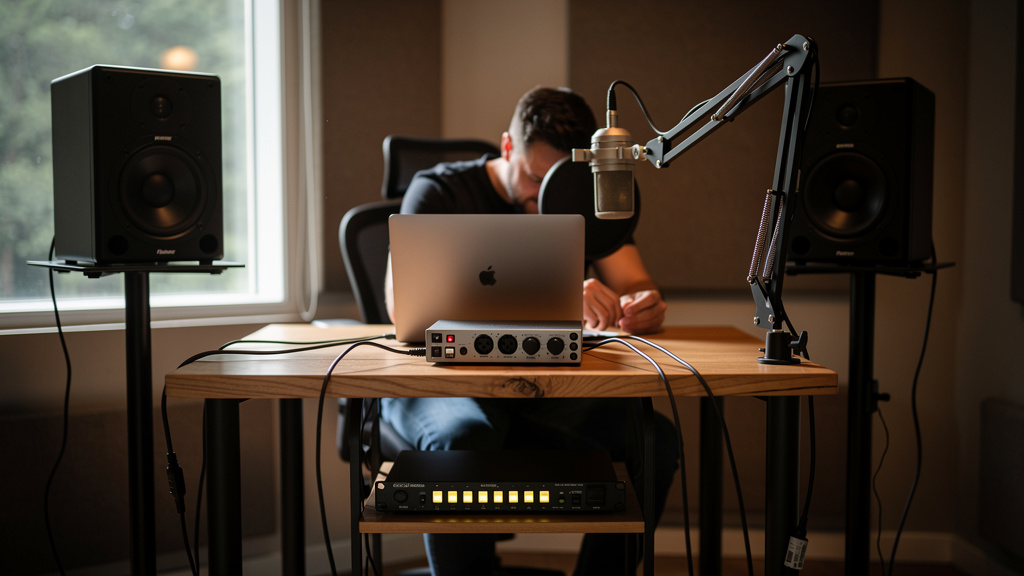
You know the feeling: the vocal is right, the room is quiet, the performer finally settles into a take that has real shape to it, and there it is underneath everything—a low hum that makes the whole recording feel smaller than it should. Not loud enough to stop the session, just stubborn enough to steal confidence. That is the maddening part. The noise floor is not exploding. It is just sitting there, flattening transients and making you second-guess gear that was working fine yesterday.
Most home and project studio owners hit that moment and start shopping for a heavier power solution. A rack conditioner with a serious faceplate feels like the grown-up answer. It looks technical, expensive, permanent. But in a surprising number of studios, the hum is not being born where people think it is. It is being completed by the way the audio system is tied together.
The good news is that this problem is usually more understandable than it looks. Once you see why the hum exists, you stop treating your entire electrical service like the enemy and start narrowing in on the actual path carrying the noise.
The silent studio you actually want
What people really mean when they say they want “clean power” is not mystical power. They want a system where the quiet parts stay quiet, where compressor makeup gain does not pull a fog up behind the source, and where sharp consonants and drum transients are not sharing space with a low-frequency smear.
A dead-silent noise floor changes how you work. Monitoring gets easier. EQ decisions get less defensive. You stop printing takes “just in case” and start trusting what comes back through the speakers. That is the relief on the other side of this problem: not just less hum, but less hesitation.
That is also why it helps to have a framework instead of random forum advice. A resource like this studio noise workbook is useful because it organizes the problem visually. It keeps you from replacing three pieces of perfectly good gear while the actual loop stays untouched.
Why the expensive conditioner myth survives
The myth survives because power devices do solve some problems. They can help with surge protection, outlet distribution, and in some cases filtering certain kinds of line contamination. If you have obvious mains-related issues, they can absolutely belong in a studio. The mistake is assuming that every audible hum is proof your room needs a thousand-dollar box in the rack.
Hum often comes from a difference in ground potential between connected devices. The key word is connected. The noise becomes audible when gear is linked through audio cabling and power grounding in a way that creates a loop current. That is why a setup can be silent with one piece unplugged, then start humming the second one connection is added. Nothing magical changed in the wall. The signal path changed.
This is where many buying decisions go off course. People hear “ground issue” and think “power problem only.” In practice, the ground reference of the audio system and the way equipment shares that reference matter just as much. A conditioner may sit upstream of the symptom without removing the path that lets the hum circulate.
What home wiring can do—and what it usually cannot
Home electrical wiring does matter, especially in older houses, mixed-use spaces, converted bedrooms, or rooms fed from questionable branch circuits. But it helps to separate realistic wiring faults from the catch-all idea of “dirty power.”
Home wiring can contribute in a few very real ways:
- Poor grounding at the outlet or circuit level
- Large appliances or dimmers sharing the same branch circuit
- Voltage drop under load
- Improperly wired outlets or inconsistent polarity
- Multiple circuits feeding interconnected studio gear
All of that can set the stage for noise, but it still does not mean every hum should be attacked with premium conditioning first. If your interface, monitors, outboard, computer, and display are spread across different outlets or circuits, the system may be creating its own invitation for loop current. The lesson is not “ignore power.” It is “understand how power and audio meet.”
A simple but important belief shift happens here: your home’s wiring may be part of the context, but the hum usually becomes audible through the interconnection of gear. That makes the problem more solvable than people fear.
The clue most studios miss
The biggest clue is when the hum changes as you add or remove one audio connection. If the hum were purely a wall-power issue, it would tend to be present regardless of signal routing. But many studios only hear it when a monitor pair is connected to an interface, when an external preamp is patched in, or when a computer joins the setup through USB and audio outputs at the same time.
That pattern tells you something valuable: the system is revealing a relationship problem, not just a utility problem.
Here are common moments when that relationship shows up:
- You connect powered monitors to an interface and the room develops a low steady buzz or hum.
- You add an external preamp or compressor and the noise appears even with no source plugged in.
- You connect a laptop power supply and the system gets noisier than it was on battery.
- You feed audio to speakers while also connecting USB to the same computer-driven setup.
- You split gear across separate wall outlets because it is physically convenient.
Those moments matter because they point toward loop formation and grounding relationships. A conditioner can still be part of a stable studio, but it is rarely the first piece of evidence that solves this pattern.
Balanced connections are not just a cable preference
One reason some home studios seem mysteriously immune to hum is that their gear is interconnected in a way that rejects trouble better from the start. Balanced audio lines do not merely sound more professional on paper. They carry signal in a way that helps cancel common noise picked up along the path and helps devices share audio more predictably.
That does not mean balanced lines are a magic shield. Poor grounding can still create problems. But when one device is feeding another over unbalanced connections across powered equipment, the system has fewer defenses. This gets especially messy when consumer and pro gear are mixed, or when adapters are used to force compatibility without understanding what reference is being tied where.
If your studio includes even a small mix of interfaces, monitor controllers, desktop synths, powered speakers, outboard gear, and a computer, your cabling format is not a cosmetic detail. It is part of the electrical behavior of the system.
What to evaluate before buying anything
Before you spend money, slow the system down and think in terms of path, not panic. You are trying to identify where the quiet system becomes a humming system.
A practical evaluation usually starts with these questions:
- Which exact connection makes the hum appear?
- Are all critical audio devices powered from the same outlet group or power distribution point?
- Are any devices connected both by audio cable and another grounded path such as USB?
- Are you mixing balanced and unbalanced connections in the same chain?
- Did the problem begin when one new item was added, or after the whole room was rearranged?
Those questions sound basic, but they reveal whether you are chasing line noise, ground potential differences, cable-format mismatches, or a specific device relationship. That distinction saves money fast.
It also protects you from the classic wrong turn: buying a conditioner, hearing a tiny change because the power layout changed slightly, and assuming the core fault has been fixed when the loop is still there waiting for the next patch change.
What a power conditioner is actually good at
Power conditioners are not fake. They are just often miscast.
Used well, they can be valuable for:
- Centralized power distribution in a rack
- Basic surge protection
- Filtering certain high-frequency mains junk in specific environments
- Sequencing or simplifying startup in some systems
What they often do not do is magically erase a ground loop that exists because two devices are connected through multiple grounding references. If the hum is being carried and completed by the signal path, the answer has to address that path.
That is the belief shift worth holding onto: a quieter studio does not always come from “better power” in the retail sense. It often comes from a cleaner grounding strategy and smarter interconnection between the devices you already own.
Action beats guesswork
Once you accept that the hum is usually traceable, the path forward gets calmer. You stop treating noise like a curse and start treating it like evidence. Something in the system is telling you where the reference is wrong, where a connection format is mismatched, or where one powered device is completing a loop through another.
You do not need to become a full-time electrical troubleshooter. You do need a method. Not a hundred contradictory posts, not a shopping spree, and not a random pile of adapters. A repeatable way to isolate where the noise enters, why it changes, and which fixes are addressing the cause instead of dressing the symptom.
If this is the kind of hum that keeps sneaking under otherwise great takes, my recommendation is to work through Kill the Noise. It is a solid resource for studio owners who want the reasoning laid out clearly before they start swapping gear or blaming the mains for everything.
Comments (0)
Leave a Comment
No comments yet. Be the first to comment!