Why a Power Conditioner Won’t Cure Your Studio Hum
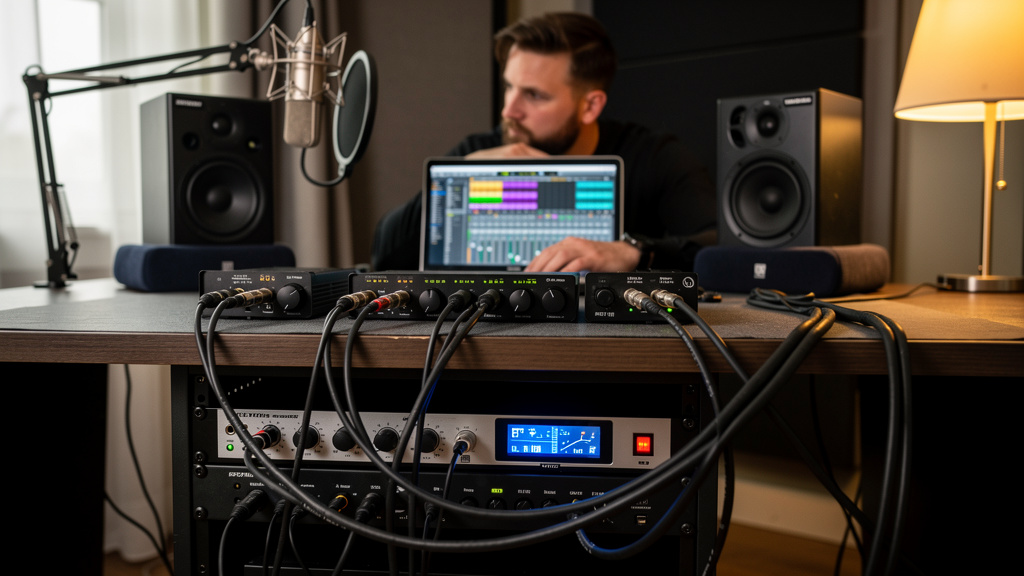
You finally get the take. The phrasing is right, the room is behaving, the performance has that little edge of honesty you can’t fake. Then you stop, solo the track, and there it is: a low, steady hum sitting underneath everything like a bad fluorescent light in a quiet hallway. At that moment, a lot of people make the same expensive assumption: the studio needs a serious power conditioner. Maybe the big rack unit with the blue meter. Maybe the one everyone swears by in forum threads. It feels like a grown-up fix. It also misses the real problem more often than people want to admit.
The uncomfortable truth is that most home-studio hum is not a cry for more expensive AC filtering. It’s a clue that current is taking a path through your audio system that you didn’t intend. The noise is often being created or invited in the signal path itself, long before a fancy power box would have any chance to help.
The expensive myth sounds logical because hum feels electrical
Hum makes people think about wall power first. That part is understandable. You hear a 50 or 60 Hz tone, maybe with harmonics stacked above it, and your brain goes straight to household electricity. So you start shopping for power products.
But “electrical” is too broad to be useful. Your studio has two systems living side by side:
- The AC power system feeding equipment
- The audio grounding and signal reference relationships between pieces of gear
Those two systems interact, but they are not the same thing. A power conditioner mainly deals with what comes in from the wall: surge suppression, some filtering, sometimes voltage monitoring. That can be useful for protection and for certain power-quality issues. What it usually does not do is erase a loop created because your interface, monitors, laptop, outboard, and maybe a cable TV or USB-connected device all disagree slightly about ground reference.
That’s why someone can spend serious money on a rack conditioner, wire everything into it beautifully, and still hear the exact same hum. All the gear is now powered from one neat strip in one metal box, but the unwanted current path in the audio system still exists.
What hum is often telling you instead
In many home setups, hum appears when two grounded devices are connected by audio cabling while also being connected to each other through the building’s electrical grounding. That creates more than one return path to ground. Tiny voltage differences between those paths can drive current where you do not want it—through shields, reference conductors, and chassis connections that are now participating in audio whether they were meant to or not.
This is why hum can seem so irrational. It shows up only when the monitors are connected to the interface. Or only when the laptop power supply is connected. Or only when a synth is patched in. Or only when the display monitor, external drive dock, and interface are all online at once.
The power coming from the wall may be perfectly ordinary. The trouble begins when the whole system becomes one connected network of competing references.
How to think like an engineer instead of a shopper
When a studio hums, the goal is not “cleaner electricity” in the abstract. The goal is to identify where the unwanted loop is closing and which connection is allowing noise current to ride alongside the audio reference.
A useful way to rebuild your understanding is to divide the problem into three questions:
- Is the noise generated inside one device? A failing power supply, dimmer, display, or cheap adapter can inject noise.
- Is the noise created by the relationship between two or more devices? That points toward a loop or reference mismatch.
- Is the noise being picked up by cabling? Long runs, improper balancing, and bad routing can make a quiet system noisy.
Hum that survives monitor swaps, cable swaps, and outlet experiments often lives in question two. That is the zone where people waste the most money because the fix is less glamorous than the purchase. It’s about topology, not prestige.
If you want a practical visual way to reason through that topology without bouncing between contradictory opinions, the Kill the Noise workbook is useful because it maps the problem like a system instead of treating hum as one mystery symptom.
Why “all my gear is on one outlet” is not a complete diagnosis
You’ll often hear that everything should be plugged into the same outlet or power strip. That advice can help reduce differences in ground potential, and in many rooms it is a smart starting point. But it is not magic.
If your monitors are fed from an interface connected to a bus-powered hub, which is tied to a laptop charger, which is connected to an external display, which is bonded to another device through HDMI or USB, your studio’s ground relationships are now bigger than one power strip. The same is true if rack gear is tied to guitar amps, pedalboards, powered speakers, or broadcast equipment in the next room.
People think they have one simple system because everything is on one desk. Electrically, they may have built several overlapping systems at once.
The devices that quietly complicate the picture
Some pieces of gear are repeat offenders—not because they are bad, but because they connect worlds that were previously separate.
- Laptops with grounded chargers
- External monitors connected by HDMI or DisplayPort
- USB hubs and docks
- Desktop computers with multiple peripherals
- Cable modem, TV, or set-top boxes nearby
- Guitar amps connected to interfaces and pedal power at the same time
- Outboard gear with mixed balanced and unbalanced I/O
Each one can create another path between chassis grounds and signal shields. The resulting hum is often stable, low-frequency, and frustratingly “professional sounding” in the worst sense—clean enough that it feels fundamental, as if the room itself is cursed.
It usually isn’t. It is usually traceable.
What a real diagnosis tends to reveal
When you strip the system down and add pieces back in logically, a few patterns show up again and again.
Balanced connections matter more than people think
A truly balanced connection does not just give you a nicer connector. It gives the receiving device a better chance of ignoring interference and separating audio from the mess riding around it. If one link in the chain falls back to unbalanced wiring—or is wired incorrectly—the whole system gets more fragile.
Some adapters “work” while creating a worse reference scheme
Any time someone says a cable “fixed” the problem, it’s worth asking what changed electrically. An adapter may not have cleaned anything; it may simply have disconnected one path while introducing another compromise. Sometimes that compromise is acceptable. Sometimes it just buries the symptom until the next piece of gear is added.
Chassis and signal ground are not always handled the way you assume
Different manufacturers bond things differently. One box may tie shield to chassis at the connector. Another may reference audio ground internally in a different way. Put enough mixed gear together and you get behavior that makes no sense if your mental model is too simple.
What power conditioners are actually good at
This is the part people rarely say clearly enough: power conditioners are not fake, and they are not useless. They are just commonly assigned the wrong job.
A solid unit can help with:
- Surge protection
- Convenient power distribution
- Sequencing in larger setups
- Basic filtering of certain high-frequency junk
- Voltage monitoring or shutdown features on some models
Those are legitimate benefits. If you own valuable gear, organized power distribution is sensible. But if your expectation is “I will install this and my 60 Hz hum will disappear,” you’re treating a system-reference problem as a product category problem.
That mismatch is why disappointment is so common.
How to tell whether your room has a true power problem
Sometimes the house wiring really is part of the story. Older homes, questionable grounding, shared appliance circuits, dimmers, or badly wired outlets can absolutely contribute to studio noise. But the signs tend to be broader than one humming signal chain.
Pay attention to patterns like these:
- Noise changes when large appliances cycle on or off
- Lights dim or flicker under ordinary load
- Different outlets in the same room behave dramatically differently
- Multiple unrelated systems exhibit issues, not just one audio chain
- You see other symptoms of wiring trouble beyond audio noise
That kind of evidence points toward the building and calls for actual electrical troubleshooting, not guesswork and not improvised “fixes” that defeat safety grounding. A studio is not the place for myths about lifting earth with cheater plugs or modifying mains wiring casually. Silence is not worth making the room unsafe.
The quieter mindset that gets better results
The biggest shift is this: stop asking, “What should I buy to clean my power?” and start asking, “Where is unwanted current flowing in relation to my audio reference?” That question is less exciting, but it is far more productive.
Once you think that way, hum stops being this vague, haunted-house symptom and starts acting like evidence. It tells you there is a relationship in the system that needs to be changed. Maybe one connection should be balanced. Maybe one device is bridging two ground domains. Maybe one cable run is exposing a weak link. Maybe the room’s wiring needs professional attention. But the fix comes from understanding the path, not from assuming the price tag of the power accessory predicts the result.
A dead-silent noise floor is usually not the reward for buying the most impressive box in the rack. It is the reward for seeing your studio as an electrical map, where every connection either keeps the signal honest or gives the noise somewhere to live.
Comments (0)
Leave a Comment
No comments yet. Be the first to comment!