Why Every Recording Studio Needs a Professional Website
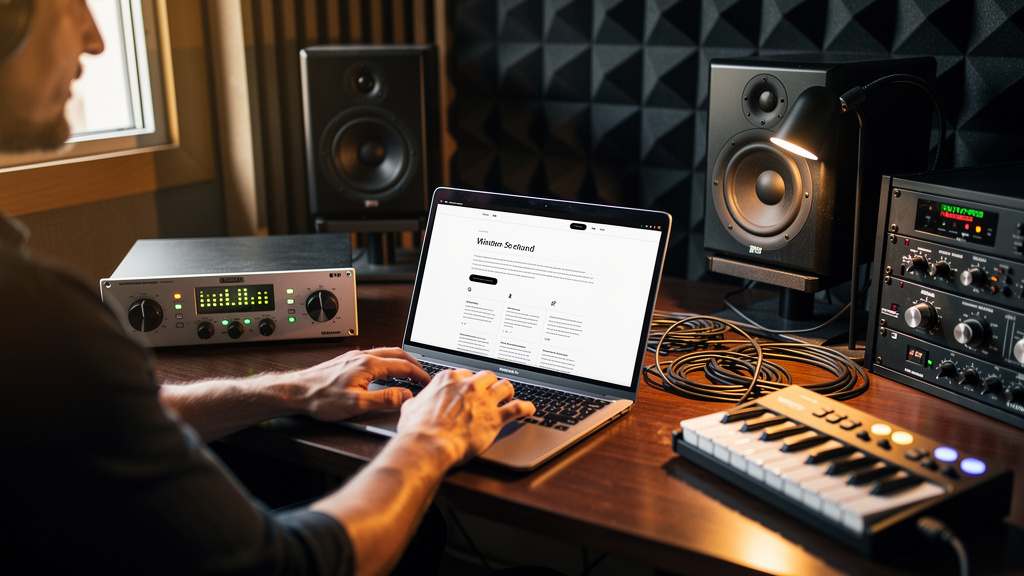
You know the feeling: someone asks for your rates, your room, your mic list, whether you do remote sessions, whether they can book a vocal block this Friday—and suddenly you are digging through Instagram posts, old text messages and a notes app just to explain your business. Meanwhile, the client is deciding whether you feel solid enough to trust with their project. That friction costs more work than most studio owners realize.
A recording studio does not need a website because “every business should have one.” It needs one because audio clients buy with their ears and their nerves. They want to know you are organized, reachable, professional and easy to work with before they ever step through the door. A strong website answers those questions quietly and convincingly.
The difference is not cosmetic. A professional website for a creative business acts like your assistant, your front desk and your best first impression all at once. It helps strangers become leads, leads become bookings, and one-time sessions become repeat clients without you having to chase every inquiry manually.
A website for a recording studio does the trust-building your socials can’t
Social media is useful, but it is rented space. Posts get buried. Stories disappear. DMs are messy. A serious client comparing three studios is not just asking, “Who has cool content?” They are asking:
- Can I see the room clearly?
- Do I understand what this studio actually offers?
- Are the rates and session options straightforward?
- Can I tell these people are dependable?
- Is booking going to be smooth or annoying?
A professional site answers all five in a few minutes. That matters for musicians on a deadline, podcasters who need a clean process, and commercial clients who have no patience for ambiguity.
When your site is built well, the client does not have to decode your business. They see the rooms, hear samples, understand the workflow, and know what the next step is. That lowers hesitation. In a service business, lower hesitation often means higher conversion.
What a good studio website actually needs
Many studios think they need a flashy homepage and a gear list. Those can help, but they are not the core job. Good studio website design guides a visitor from curiosity to confidence to action. At minimum, your site should cover a few practical bases.
- A clear offer. Spell out what you do: recording, mixing, podcast production, vocal sessions, editing, live tracking, remote services, production, mastering coordination, rehearsal capture, or content creation.
- Room and experience proof. Show the space honestly. Include photos that reveal scale, cleanliness, vibe and workflow, not just moody closeups of preamps.
- Simple next steps. Every page should make it obvious how to book, ask a question or request a quote.
- Pricing guidance. You do not always need full public rates, but some structure helps serious prospects qualify themselves.
- Audio credibility. Feature selected work, testimonials and concise details about your process.
- Operational clarity. Parking, location, session policies, file delivery, turnaround times and cancellation terms all reduce back-and-forth.
Notice what is missing: gimmicks. Studio owners often over-focus on aesthetics and under-focus on client friction. The best website for a recording studio feels easy. It anticipates the practical questions a paying client has and answers them before they need to ask.
Why “just having a site” is not enough
An outdated site can hurt more than no site at all. If your pages load slowly, your contact form fails, your photos are years old, or your mobile experience is rough, the message is not neutral. It says your operation may be disorganized. That is a dangerous signal in an industry where clients already worry about wasting time, money and performances.
This is where professional execution matters. Good studio website design built around bookings is less about decoration and more about flow. The visitor should land on the site and immediately understand who you serve, what sessions you run, what kind of work comes out of the room, and how to take the next step.
For many studios, the biggest missed opportunity is not traffic. It is conversion. Plenty of owners have enough local awareness, referrals and social activity to generate interest. They simply do not have a site structured to catch that interest properly.
A website with online booking saves studio owners from admin sprawl
Most small studios do not lose time in one dramatic place. They lose it in fragments: replying to availability questions, following up on ghosted inquiries, reminding clients to confirm, collecting missing details, and trying to remember who wanted a monthly podcast slot versus who wanted a one-off vocal session.
This is why a website with online booking becomes more than a brochure. It turns your site into an operational tool.
Done properly, an appointment booking website can:
- let clients request or reserve session time
- collect project details before the session
- sort leads by service type
- send confirmations and reminders automatically
- reduce no-shows and vague inquiries
- free you from constant back-and-forth messaging
If your business has repeat bookings, consultation calls, podcast blocks, mixing intake, or recurring production work, this gets even more valuable. A CRM and sales funnel website is not overkill for a studio—it is often the difference between a business you run and a business that runs you.
That matters especially for owner-operators. Every hour you spend on scattered admin is an hour you are not editing, tracking, mixing, networking or resting your ears.
How to get more studio bookings online without sounding salesy
Studios sometimes resist stronger sales structure because they do not want to feel pushy. Fair enough. Nobody wants their site to read like a used-car pitch. But clarity is not pushy. Clarity is respectful.
If you want to get more studio bookings online, your site should move through a simple sequence:
- Show relevance. Speak directly to the kinds of clients you want—artists, podcasters, voice talent, labels, agencies, content teams.
- Prove capability. Use room photos, selected credits, audio samples and concise testimonials.
- Reduce uncertainty. Explain rates, process, deliverables, turnaround and logistics.
- Invite action. Offer one clear next move: book a session, request a quote, schedule a call, or submit project details.
That is not hype. It is signal flow for decision-making. A lead comes in uncertain, and your website routes that uncertainty toward confidence.
This also helps you attract better-fit clients. People who understand your process before reaching out are more likely to respect your time, your policies and your rates.
Professional presentation affects how clients value your rates
One uncomfortable truth: people do judge price through presentation. Two studios can charge similar rates, use comparable gear and produce similarly strong work—but the one with the sharper digital presence often feels safer to book.
That does not mean expensive-looking for the sake of it. It means coherent, current and intentional. Clean photos. Consistent messaging. A smooth mobile experience. Fast load times. Strong calls to action. Real information. Those things shape perceived value before you ever discuss a day rate.
Your website is often the first “session” a client has with you. If that experience feels smooth, they assume the rest of your workflow probably is too.
That perception can support premium pricing, reduce haggling and make referral partners more comfortable sending work your way.
When to hire a web designer for your studio
Some owners can build a decent starter site themselves. But there is a point where DIY starts costing more than it saves—usually when the site is supposed to do real business work, not just exist online.
You should seriously consider done-for-you help if:
- your site looks dated on mobile
- you rely on DMs and email threads to manage bookings
- your contact form brings weak or incomplete inquiries
- you cannot update offers or pages confidently
- you want automation, CRM and booking tools connected properly
- you are getting traffic but not enough qualified leads
This is where specialized web design services for small business matter, especially from a team that understands recording studios and creative-service sales cycles. General templates often miss the way studios actually book work: by trust, workflow clarity, niche positioning and repeat relationship-building.
If you want a custom website design for small business use that is built around the way studios really operate, AleXavior’s done-for-you web services for studios are a smart next step. The value is not just a nicer homepage. It is having booking, lead capture, follow-up and client management built into the same system.
Your website should sound like your studio feels
The best studio sites have the same quality as a well-run session: calm, clear, focused and confidence-building. They do not overwhelm. They do not hide basic facts. They do not make a serious client work too hard to understand the room or the process.
If your current online presence depends on scattered links, social proof without structure, and manual follow-up for every inquiry, you are probably leaving bookings on the table. Not because your work is weak, but because your presentation creates friction where there should be flow.
A professional website is not extra polish for a recording studio. It is part of the business infrastructure. It helps clients trust you faster, book you easier and come back with less resistance next time. For a studio owner trying to build stable revenue, that is not a luxury. It is basic signal path.
Comments (0)
Leave a Comment
No comments yet. Be the first to comment!