Why Production Businesses Lose Clients Without a Proper Website
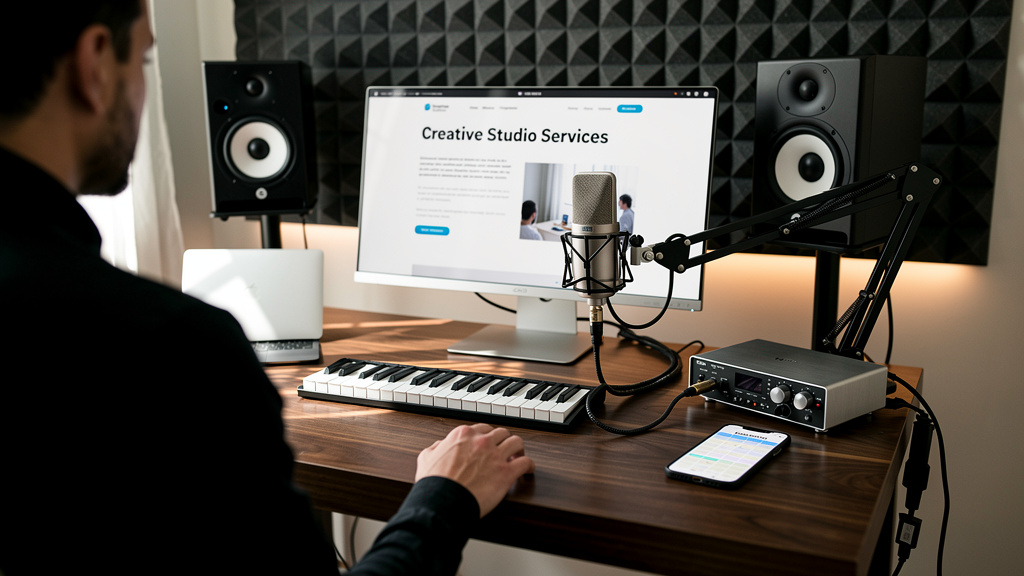
You know the feeling: someone hears your work, likes your reel, maybe even gets a warm referral, and then goes quiet. No reply. No call. No booking. Most production owners assume the lead got busy or picked a cheaper option. Sometimes that is true. But a lot of the time, they checked you out online, didn’t get the clarity or confidence they needed, and moved on to the next person.
That stings because your actual work may be excellent. The problem is not always your mixes, your room, or your rates. It is often the gap between interest and trust. For a production company, studio, podcast editor, or content team, a website is where that trust either gets built or quietly falls apart.
A proper site is not just a digital business card. It is the part of your business that answers the questions prospects are too busy, too cautious, or too awkward to ask directly: What do you actually do? Who is this for? What does it cost? How do I book? Are you reliable? Are you current? Are you the kind of operator who can carry a project without drama?
Clients do not just hire your sound. They hire your process.
When buyers evaluate a production partner, they are not only listening for quality. They are scanning for friction. A weak website creates uncertainty around response times, scheduling, revisions, file delivery, professionalism, and whether you can handle a commercial relationship cleanly.
That matters even more in production than in many service businesses, because clients often cannot judge technical quality deeply. A podcaster may not know how to evaluate room treatment or editing decisions. A local brand may not know what makes one voiceover production chain stronger than another. So they use the signals they can understand. Your site becomes one of those signals.
If your website is outdated, vague, slow, missing mobile polish, or hard to navigate, prospects start making assumptions. Usually not generous ones.
They may assume:
- You are hard to reach.
- Your workflow is improvised.
- You are part-time or inconsistent.
- Your business is not stable enough for an important project.
- Working with you will involve too much back-and-forth.
None of those assumptions may be fair. They still cost bookings.
Where production businesses lose clients online
Most lost leads happen in a few predictable places. Not because owners do not care, but because the site was built quickly, patched together over time, or never designed around how clients actually make decisions.
1. The homepage talks about you, not the client
A lot of sites open with generic language about passion, creativity, and high-quality production. That sounds pleasant, but it does not answer the visitor’s real question: “Can you solve my specific problem?”
A better website for a recording studio or production business quickly tells the visitor what you do, who you do it for, and what the next step is. A musician wants to know if you track bands, produce singles, or mix remotely. A podcaster wants to know if you handle cleanup, episode editing, and publishing support. A corporate client wants to know if you can produce fast, polished deliverables without babysitting.
Clarity beats cleverness every time.
2. There is no obvious path to book or inquire
If someone has to hunt for your contact page, send a vague email, and wait two days for a reply, many will not bother. They will pick the provider whose process feels easier.
This is why a website with online booking or at least a very clear inquiry flow matters. It reduces hesitation. It also filters better leads because people understand what kind of project you take on before they reach out.
A proper site should make the next action obvious:
- Book a discovery call
- Request a quote
- Check availability
- Start a project inquiry
The goal is not pressure. It is momentum.
3. Your services are bundled into a blur
“Audio services” is too broad. “Production” is too broad. Clients do not want to decode your menu.
Good studio website design separates services in a way buyers recognize. Recording, mixing, mastering, editing, voiceover production, podcast post, music production, consultation, studio rental: each should have a plain-language explanation, a short process overview, and some indication of fit.
When people cannot tell whether you are right for their project, they rarely ask. They leave.
4. The portfolio is strong, but context is missing
A reel without framing can underperform. A few great examples with the right explanation often sell better than a giant wall of embeds.
Tell the visitor what they are hearing and why it matters. Was this tracked live? Was the challenge noisy source audio? Did you turn around branded podcast episodes on a weekly schedule? Did you help an artist go from demo to release-ready single?
Clients respond to outcomes and problem-solving, not just polish.
5. The site does not support the sales follow-up
A lead form that dumps emails into your inbox is better than nothing, but it leaves money on the table. Many production businesses lose clients simply because they do not follow up consistently, or they cannot track where leads came from, what service they wanted, or where they stalled.
That is where a done-for-you website built around bookings and follow-up can change the economics of the business. When inquiry forms, scheduling, CRM tracking, and automated emails work together, fewer leads slip through the cracks and more conversations actually turn into paid work.
What a professional website for a creative business needs to do
A proper site should reduce uncertainty at every stage. It should make your business feel easy to trust and easy to hire.
At minimum, it should do these jobs well:
- Position your offer clearly. State what you do, for whom, and what kind of projects you want.
- Show relevant proof. Include samples, case-style explanations, testimonials, or client outcomes that match your target market.
- Handle objections. Answer practical questions about turnaround, revisions, deliverables, remote workflow, booking, and payment before they become reasons to leave.
- Create a simple next step. Give visitors a low-friction path to inquire or schedule.
- Support follow-through. Use forms, automations, and CRM structure so no serious lead disappears into admin chaos.
This is the difference between having a website and having one that helps you get more studio bookings online. A proper site works like part of your sales process, not just your branding.
How to audit your current site in 15 minutes
If you want to know whether your website is costing you work, run this quick check from the perspective of a first-time buyer.
- Open your site on your phone, not your studio computer.
- Ask whether the homepage explains your offer in five seconds.
- See if a new visitor can tell exactly what services you provide.
- Check whether there is a clear call to action above the fold.
- Look for any dead pages, stale credits, broken embeds, or old dates.
- Time how long it takes to submit an inquiry.
- Ask a friend outside audio what they think you actually sell.
If any of those steps produce confusion, hesitation, or friction, prospects are feeling it too.
One more thing: review your site through a local search lens. Even if referrals drive most of your business, basic local SEO for studios still matters when someone searches your name, your city, or a service you offer. If your pages do not clearly mention your location and service areas, you make it harder for warm leads to confirm they have found the right provider.
Why referrals still need a strong website
Some owners think they can ignore this because nearly all their work comes from word of mouth. In practice, referrals make a strong website more important, not less.
A referred lead is usually not choosing whether to trust the person who sent them. They are choosing whether to trust you. Before they reply, they want to validate the recommendation. They check your site to see if your business feels current, specialized, and easy to work with.
If that referral lands on a weak website, the recommendation loses force. If they land on a clean, focused, professional web presence, the referral gets reinforced.
That is especially true for higher-value projects. The bigger the budget, the more the buyer needs evidence that your business can handle communication, scheduling, and delivery like a professional operation.
What to improve first if your site is underperforming
You do not have to rebuild everything at once. Start with the pages and decisions that have the biggest impact on trust and conversion.
- Rewrite your homepage headline around the client problem you solve.
- Separate your services into distinct pages or sections.
- Add a stronger inquiry or appointment booking website flow.
- Replace generic portfolio embeds with examples plus short context.
- Answer common booking questions before the contact form.
- Make your mobile experience fast and clean.
If you have reached the point where patching things together is taking more time than it saves, it may be time to hire a web designer for your studio or production business who understands both creative services and lead generation. A site for this industry needs more than good visuals. It needs structure, messaging, and a working sales path.
For owners who would rather stay focused on sessions, edits, and client work, AleXavior offers web design services for small business owners in audio with booking, CRM, and sales funnel features built around how production businesses actually win work. That kind of setup does not just make the site look better. It helps the business run better.
The hard truth is simple: many production businesses are not losing clients because they lack talent. They are losing them because their website fails at the quiet middle part of the sale, where curiosity is supposed to become confidence. Fix that, and more of the interest you already earned starts turning into real projects.
Comments (0)
Leave a Comment
No comments yet. Be the first to comment!