Your Quietest Cable Upgrade Has Nothing to Do With Gold
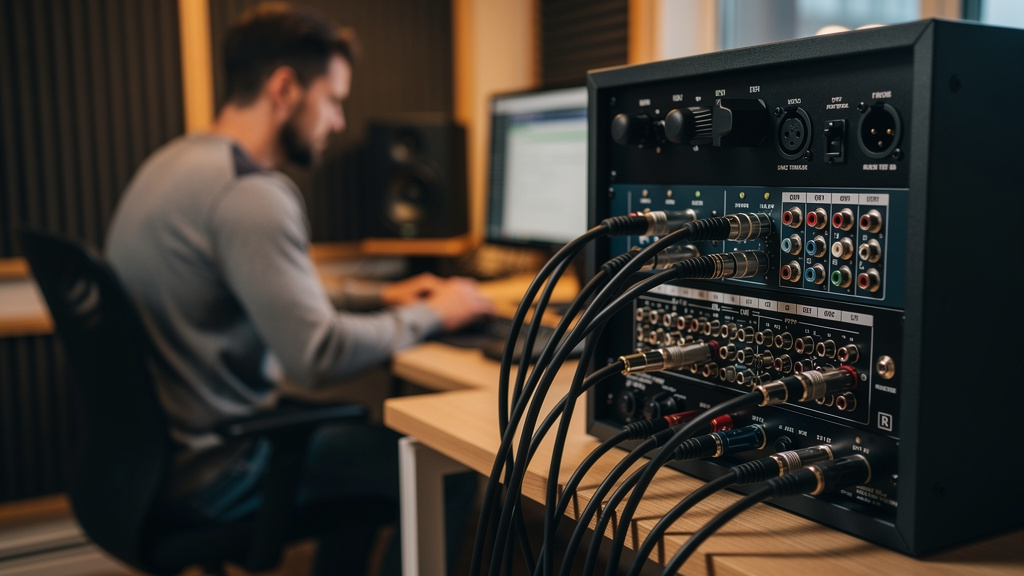
You know the feeling: you upgrade the interface, buy the “better” cables, tidy the desk, and still something in the room feels smaller than it should. The stereo image is a little fragile. The low end loses confidence on longer runs. A faint hash creeps in when gear combinations change. It is not dramatic enough to count as a total failure, but it is enough to make every mix feel like it is giving away headroom and focus before you even start.
That is the maddening part of signal path problems. They rarely announce themselves with one obvious catastrophe. More often, they shave off trust. You stop believing what the speakers are telling you. You print another take. You swap plugins. You blame converters. Meanwhile, the real issue is often much more basic: the way your studio is carrying signal from one box to the next.
The good news is that this is usually fixable, and not by buying more decorative metal. Gold plating has its place for corrosion resistance at the connector surface, but it does not magically lower your noise floor or restore dynamic range in a badly wired setup. Quiet, stable audio comes from balanced transmission where it belongs, sensible cable lengths, and a grounding scheme that is not fighting itself.
What you actually want from a cable path
Most studio owners say they want “better cables,” but what they really want is confidence. They want to push a vocal up without a haze appearing behind it. They want synths to stay full on a six-foot run and remain full on a twenty-foot run. They want monitor feeds that do not change character when a laptop, screen, or outboard box joins the chain.
A robust signal path does three very practical jobs:
- It carries the wanted audio at the right level.
- It rejects interference picked up along the way.
- It keeps equipment grounds from becoming part of the audio story.
If any one of those jobs is compromised, the result can sound like “bad gear” when it is really just bad compatibility between outputs, inputs, cable type, and grounding.
Balanced is not a marketing term
Balanced audio gets treated like a luxury feature when it is really a noise-control method. In a balanced connection, the receiving input compares two versions of the signal that are equal and opposite. Noise induced along the cable tends to appear similarly on both conductors, so the differential input rejects it. That rejection is the whole point.
This is why balanced lines matter most where the real world is messy: longer runs, cable bundles, wall power nearby, computer-heavy desks, monitor feeds, patchbays, and rooms where multiple grounded devices share space. In those conditions, balanced cabling is not audiophile theater. It is basic studio hygiene.
Unbalanced connections can still be perfectly fine in the right place. Short instrument runs from a guitar to a DI are a normal example. Certain synth outputs and pedal chains are also naturally unbalanced. The mistake is not using unbalanced gear at all. The mistake is asking an unbalanced connection to behave like a balanced one over distance or across a grounding mess.
XLR and TRS are not the same thing as balanced and unbalanced
This is where a lot of expensive confusion starts. XLR is commonly balanced. TRS can be balanced, but it can also carry a stereo headphone signal or an insert send/return depending on the gear. TS is typically unbalanced. The connector shape tells you less than people think. What matters is the circuit on each end.
Before you trust a cable choice, verify these three things:
- The output type. Is the source truly balanced, impedance-balanced, or unbalanced?
- The input type. Is the destination expecting balanced line level, instrument level, or something else?
- The pin or conductor wiring. Are tip, ring, sleeve or pin 2, pin 3, and shield being used the way both devices intend?
That last point is where “mystery thinness” often enters. A mismatched cable can feed the right signal level into the wrong kind of input reference, partially canceling content or inviting noise into the shield path. The result may not be obvious hum. It may simply be less solidity, less separation, and less usable range before things feel brittle.
Why long runs expose weak wiring decisions
Short runs are forgiving. A three-foot cable between two devices on the same desk can hide all kinds of mediocre choices. Stretch that run across a room, route it near power, add a second monitor, a USB hub, and an outboard compressor, and suddenly the hidden weakness becomes audible.
Longer runs raise the stakes because the cable becomes a better collector of the electrical mess around it. That does not mean you need boutique cable jewelry. It means you need the right topology for the job. Balanced line-level runs are far more tolerant in a busy studio than unbalanced ones, especially when your room is full of switched power supplies, screens, chargers, and computing gear.
If you are trying to diagnose a path that feels compromised, a visual workbook for tracing studio noise at the source can help you think through the actual path instead of guessing which shiny part to replace next.
The shield is not there to carry your whole audio life
One of the least understood parts of studio cabling is the shield. People tend to think of it as just “the ground part,” but in practice the shield can become the stage where your problems perform. In a clean balanced line, the signal is carried by the two conductors, while the shield helps screen the pair from external interference. When gear grounds are poorly arranged, that shield may also end up carrying unwanted current between devices.
That is when things get slippery. You can have a cable that is technically intact, connectors that are physically solid, and still hear noise or lose clarity because the shield is doing more work than it should. Once the shield becomes a traffic lane for ground current, the audio path is no longer living in peace.
This is why “better plating” is such a poor answer to most studio noise problems. Gold does not fix current flowing where it should not flow. Gold does not turn an unbalanced output into a balanced one. Gold does not solve a monitor path that shares ugly ground relationships with a computer rig. It may help a connector resist oxidation over time, which is nice. That is a maintenance advantage, not a miracle.
The expensive myth that keeps people stuck
There is a persistent belief that if a setup still sounds compromised, the missing ingredient must be more premium cable stock, more exotic metallurgy, or heavier connectors. That belief survives because it is emotionally satisfying. It lets you buy your way out of a wiring problem without having to map the system.
But studio signal paths do not care about mythology. They care about compatibility.
Here is what actually moves the needle more than plating in most small rooms:
- Balanced monitor feeds instead of long unbalanced runs
- Correct output-to-input matching between devices
- Short unbalanced runs where unbalanced must be used
- Thoughtful separation of audio cabling from power supplies and adapters
- Grounding relationships that do not force shields to carry unwanted current
Get those right and ordinary professional cabling often performs beautifully. Get them wrong and luxury connectors simply preserve the wrong setup in higher style.
How this shows up in real studios
A lot of creators meet this problem in the same few places. Not because they are careless, but because modern hybrid studios mix consumer electronics, pro audio gear, USB-powered devices, and furniture-driven cable routes that were never designed for low-noise audio.
Watch for these patterns:
- A monitor controller feeding speakers over the wrong cable type
- Interface outputs hitting powered monitors with ground relationships that change when a laptop charger is connected
- Rack gear patched with cables chosen by connector shape instead of circuit type
- Stereo synths running unbalanced across the room when a better conversion point could exist closer to the source
- Patchbays normaling signals in ways that quietly create mismatches
None of that is glamorous. All of it affects how much of your system’s real dynamic range survives the trip.
Build belief by testing the path, not the price tag
If you want relief from the constant second-guessing, stop asking whether a cable is “high end” and start asking whether the path makes electrical sense. That one shift changes everything.
A useful troubleshooting mindset looks like this:
- Identify which runs truly need to be balanced.
- Confirm what each device is actually sending and expecting.
- Reduce unnecessary length wherever the signal is unbalanced.
- Notice where shield connections and chassis grounds may be interacting.
- Change one relationship at a time so the cause becomes visible.
The reason this works is simple: audio problems become solvable the moment they stop being mystical. A studio is a system. Systems respond to logic better than hope.
You do not need to become an electrical engineer overnight, but you do need a clearer picture than “XLR good, anything expensive better.” That shortcut leaves too many rooms sounding smaller and noisier than the gear budget says they should.
The payoff is bigger than less noise
When the cabling and grounding are right, the benefit is not just silence between notes. It is trust. Transients feel cleaner. Pans hold their shape. Reverb tails read more honestly. Compression decisions get easier because you are not leaning into hidden junk riding underneath the source.
That is why signal-path work matters so much. It does not just remove distractions. It gives the rest of your craft a stable surface to stand on.
If your setup still feels like it is leaving clarity on the table, I’d recommend working through Kill the Noise. It is a practical way to sort through balancing, shield behavior, and ground-related noise without getting lost in conflicting forum advice.
Comments (0)
Leave a Comment
No comments yet. Be the first to comment!